Types of Barcodes Explained: Choosing the Right Format for Smart Asset ID Labels
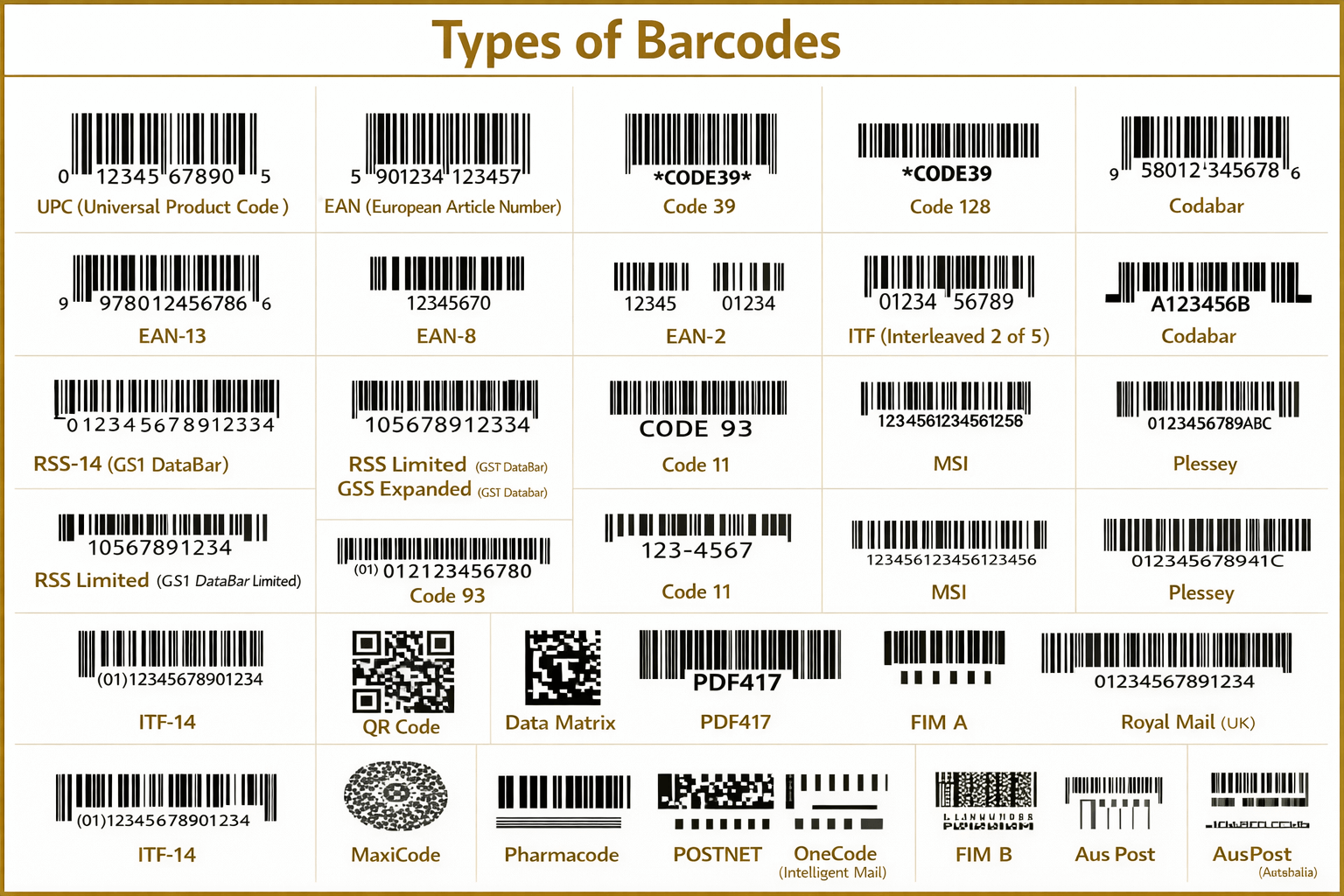
Barcodes are the backbone of modern inventory, asset tracking, and operational efficiency. The image above showcases a wide range of barcode symbologies—from traditional retail codes to advanced 2D formats. Understanding these barcode types is essential if you're looking to implement Asset ID labels with variable data, which can dramatically improve tracking, compliance, and automation across your business.
At Intertronix, we specialize in helping companies deploy intelligent labeling systems—and choosing the right barcode is where it all begins.
1. Retail & Global Trade Barcodes
UPC (Universal Product Code)
Common in North America retail
Fixed-length numeric code
Ideal for product identification at point-of-sale
Asset ID Insight: UPC is not ideal for asset tracking because it lacks flexibility for variable data like serial numbers or locations.
Asset ID Insight: Like UPC, EAN is standardized and static—better for products than assets requiring unique identifiers.
2. Industrial & Logistics Barcodes
Code 39
Alphanumeric (letters + numbers)
Widely used in manufacturing and defense
Why it matters for Asset IDs: A strong candidate for asset labels. It supports variable data such as:
Serial numbers
Equipment IDs
Location codes
Code 128
High-density, compact barcode
Supports full ASCII character set
Asset ID Advantage: One of the best choices for Asset ID labels because it:
Encodes more data in less space
Supports variable, complex information
Improves scan reliability
ITF (Interleaved 2 of 5) & ITF-14
Numeric-only, used in packaging and cartons
Asset ID Insight: Useful for logistics but limited for assets due to lack of alphanumeric flexibility.
Codabar
Used in libraries, blood banks, logistics
Asset ID Insight: Simple but outdated—better replaced with more robust formats like Code 128.
3. Specialized & Legacy Formats
Code 93 & Code 11
Compact and more secure than Code 39
Used in niche applications (telecom, electronics)
Asset ID Insight: Can support variable data, but less common than Code 128.
MSI & Plessey
Used in inventory control and retail shelving
Asset ID Insight: Limited adoption—generally not recommended for modern asset tracking systems.
4. GS1 DataBar (RSS Family)
RSS-14, RSS Limited, GS1 DataBar Expanded
Encodes more data than UPC/EAN
Used in fresh foods and regulated industries
Asset ID Insight: Good for compliance-heavy industries, but not as flexible as 2D codes for asset labeling.
5. 2D Barcodes (The Future of Asset ID Labels)
QR Code
Stores large amounts of data
Scannable by smartphones
Asset ID Advantage: Perfect for modern asset tracking:
Store URLs, manuals, maintenance logs
Enable mobile-based asset management
Ideal for variable, dynamic data
Data Matrix
Extremely compact, high-density code
Used in electronics, healthcare, aerospace
Best for Asset Labels When Space is Limited:
Direct part marking (DPM)
Tiny components
High durability environments
PDF417
Stacked linear barcode
Holds large datasets (IDs, documents)
Asset ID Use Case: Useful when assets require embedded records such as compliance or certifications.
6. Postal & Carrier Barcodes
Includes:
POSTNET
OneCode (Intelligent Mail)
Royal Mail
AusPost
FIM A / FIM B
Asset ID Insight: These are highly specialized for mail systems—not suitable for general asset labeling.
7. Unique & Advanced Formats
MaxiCode
Used by shipping carriers (e.g., UPS)
Handles high-speed sorting
Pharmacode
Used in pharmaceutical packaging
Asset ID Insight: Industry-specific—rarely used for general asset tracking.
Why Barcode Choice Matters for Asset ID Labels
When implementing an Asset ID labeling system, your barcode must do more than identify—it must adapt.
Key Requirements for Modern Asset Labels:
Variable data support (unique IDs, serial numbers, locations)
High scan reliability
Durability in harsh environments
Integration with asset management software
Best Barcode Types for Asset ID Labels
For most applications, we recommend:
Code 128 (Best All-Around Linear Option)
Flexible, compact, and widely supported
Ideal for warehouses, manufacturing, and IT assets
QR Code (Best for Smart, Connected Assets)
Enables mobile interaction
Supports dynamic data and cloud integration
Data Matrix (Best for Small or Industrial Assets)
High density in small spaces
Perfect for electronics and durable goods
Turning Barcodes into Smart Asset Intelligence
At Intertronix, we go beyond printing labels—we help you create intelligent asset ecosystems.
By combining:
Variable barcode data
Durable label materials
Asset management software
You can transform simple labels into powerful tools for:
Real-time tracking
Preventative maintenance
Audit compliance
Loss prevention
Final Thoughts
Not all barcodes are created equal. While retail formats like UPC and EAN dominate consumer goods, industrial and 2D barcodes unlock the true potential of Asset ID labels.
If your goal is to track, manage, and optimize assets, the right barcode—paired with variable data—is your competitive advantage.
Ready to upgrade your asset labeling system? Visit www.intertronix.com to explore custom Asset ID solutions tailored to your business.
Linear (1D) BarcodesThese consist of straight lines and spaces that scanners read horizontally, encoding information like numbers or letters.
Universal Product Code (UPC): This 12-digit system is a staple in American stores for identifying items during checkout. It assigns unique codes to makers and goods, ending with a verification digit to catch errors, and is ideal for everyday consumer products like food and electronics.
European Article Number (EAN): An international counterpart to UPC, this format supports global trade. Variants include the 13-digit version for standard merchandise, an 8-digit compact option for tiny packages, and a 2-digit add-on for extras like periodical editions. It's prevalent in shops worldwide, ensuring seamless product recognition across borders.
Code 39: Capable of holding letters, digits, and select symbols (up to 43 in total), this versatile option finds use in factories, vehicle parts, medical settings, and military logistics for labeling and monitoring inventory. It includes built-in safeguards and an optional error-check code.
Code 128: A space-saving design that packs in the entire standard character set, including special symbols, making it efficient for transport, storage facilities, and distribution. It's favored for its flexibility in length and ability to handle complex data without wasting room.
Codabar: Originally crafted for medical and library applications, this digit-focused code (with limited letters for markers) appears in labs, delivery services like couriers, and health records. Though not as widespread today, it handles flexible data sizes effectively.
Interleaved 2 of 5 (ITF): This digit-only method interleaves pairs for compactness, suiting bulk packaging, warehouses, and shipping crates. It demands even-numbered entries and excels in high-volume environments where quick scans matter.
ITF-14: An extended take on ITF, this 14-digit code is tailored for outer boxes and wholesale units, incorporating global trade identifiers. It's rugged enough for tough surfaces like cardboard and supports large-scale logistics.
GS1 DataBar Family (including RSS-14, RSS Limited, and Expanded Versions): These slim designs are perfect for perishable items like fruits or discount vouchers. The 14-digit base handles core info; the limited one fits tiny labels with digit constraints; the expanded adds details like dates or weights. They're optimized for crowded retail spaces.
Code 93: A denser alternative to similar codes, it supports full text and symbols while staying compact. Common in delivery networks, shops, and some mail systems, it offers strong error detection for reliable tracking.
Code 11: Focused on numbers (plus hyphens), this high-packing format is mainly for telecom gear labeling. It uses mandatory checks to minimize mistakes, though it's sensitive to print quality.
MSI Plessey: A straightforward digit-based system with built-in validation, often seen in stockrooms and store shelves for organizing goods. It's basic yet effective for internal tracking.
Plessey: An early digit-only style using pulse variations, it's used in book collections, food storage, and certain regional shops. While dated, it persists in niche areas but is being phased out for modern alternatives.
Pharmacode: Unlike typical numeric systems, this binary setup controls drug manufacturing lines, representing values in a directional read. It spans a wide numeric range and ensures precision in production.
Postal Numeric Encoding Technique (POSTNET): Employed by U.S. mail services for address codes, it uses bar heights to automate sorting. It's simple and aids in directing envelopes efficiently.
Intelligent Mail Barcode (OneCode): A U.S. postal upgrade that merges address and monitoring data into one, supporting detailed tracking with error fixes. It streamlines mail handling beyond older formats.
Facing Identification Marks (FIM A and FIM B): Basic U.S. mail indicators using bar patterns to align and categorize envelopes automatically. A version handles prepaid replies, while B is for business returns, speeding up processing.
Royal Mail (UK): This multi-state code for British addresses includes letters and numbers for precise sorting. It adapts to customer details and enhances delivery accuracy.
Australia Post (AusPost): A patterned code for Australian mail, it identifies destinations with error spotting to guide packages reliably through the system.
Two-Dimensional (2D) BarcodesThese use grids or matrices to store more complex data, readable from any angle and often holding text, links, or files.
Quick Response (QR) Code: A block-based square that can embed extensive info like web addresses or messages, with quick scan times and damage resistance. It's popular for ads, transactions, and info sharing via phones.
Data Matrix: A small grid pattern that fits substantial text or numbers on tiny surfaces, like circuit boards or medical tools. Its robustness makes it suitable for tech, health, and aviation marking.
PDF417: Layered rows of lines form this stackable design, accommodating large text blocks or data sets. It's common in official documents, travel passes, and IDs for secure, portable info.
MaxiCode: A circular, hex-shaped pattern designed for fast parcel scanning in shipping hubs. It holds key logistics details with recovery features for uninterrupted operations.
 866.980.9525 M-F 9am-5pm PST | We Ship Worldwide